
High-Frequency Melamine Powder Preheater
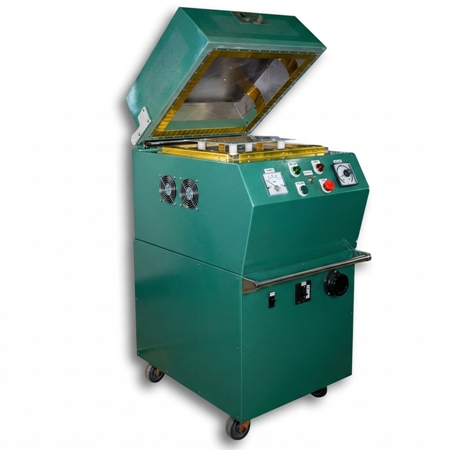
Han Chang’s high frequency preheater turns melamine powder into a soft charge before compression molding. Timed heating ends with automatic lid opening for manual unloading and transfer to the mold.
Practical advantages for compound preparation
Prepare the charge before it reaches the mold
Move part of the material’s temperature rise upstream. Melamine powder becomes a soft preheated charge ready for mold loading, while the downstream press carries out molding and curing. This gives tableware factories a focused addition to the material-preparation stage.
Finish each heating batch with a clear handoff
At the end of the set heating time, heating stops and the lid opens automatically. The operator can then remove the charge and transfer it to the mold. Set the heating time around the compound and loading conditions rather than relying on one setting for every job.
Eliminate manual lifting and lowering of the lid
The lid opens and closes automatically, reducing repeated lid handling for each batch. Operators weigh, load, unload and transfer the charge as part of the factory’s compression molding routine.
Add preheating around the press you already own
Integrate upstream preparation with a suitable single-color, two-color, three-color or cup molding process. Five power options support equipment selection around the actual charge and plant supply, keeping the investment focused on preheating rather than replacing a working line.
From powder to a soft charge, then into the mold
High-frequency, or radio-frequency (RF), preheating uses dielectric heating in suitable thermoset molding compounds. Melamine powder forms a soft cake or lumps before manual transfer to the heated compression mold.
Official Han Chang video · Watch on YouTube
Stage 1: Load the compound and run timed heating
Weigh the required charge into a suitable preheating container, then place the container in the machine manually.
The lid opens and closes automatically. Set the heating time to suit the compound and loading conditions, and run the preheating stage.
Stage 2: Automatic opening and manual mold loading
When the set time ends, heating stops and the lid opens automatically. The melamine compound is now a soft preheated cake or lumps.
Remove the container manually and tip the preheated charge into the mold. The downstream press performs pressing, degassing and curing.
Coordinate completion of preheating with the next mold charge and avoid unnecessary travel or waiting, helping the preheated material reach the mold in the intended condition.
Materials and production-line applications
Melamine tableware preparation
Prepare molding compound for bowls, plates, cups and trays. Transfer the soft preheated cake into the mold, where the press completes compression molding and curing.
Suitable UF and phenolic compounds
Preheating can also be planned for suitable urea-formaldehyde and phenolic thermoset molding compounds. Match the configuration to the actual formulation, charge and downstream molding requirements.
Existing press lines
Position the preheater around the operator’s loading route and mold access. Preserve the use of a suitable existing press while adding upstream compound preparation.
New tableware production
Select preheating and molding equipment together around each charge and the press-loading schedule. Coordinated preparation avoids building a workflow around power ratings alone.
Power options and equipment selection
Han Chang offers 3, 5, 7, 10 and 25 kW RF preheater models. Match the compound, charge weight and preheating requirement with container space, the press-loading schedule and available plant supply.
Specify the charge before choosing the machine
Start with the material, current charge weight, or a product and press photo. Container dimensions, production schedule, target output and plant supply help narrow the configuration when available. Buyers do not need to select a power option before requesting a quotation.
The five separate power models offer a choice for different batch and production requirements.
| Performance / Model | 3 kW preheating model | 5 kW preheating model | 7 kW preheating model | 10 kW preheating model |
| Performance / Model | 25 kW preheating model |
A preheater for your existing press—or equipment for a new line
Han Chang supplies high-frequency preheaters alongside melamine tableware molding and finishing equipment. Add the preheating stage to an existing press setup, or source the main equipment for a new melamine tableware production line from one supplier.
Add preheating to an existing line
Prepare the melamine molding powder before it enters the press. The preheater produces a soft cake that the operator removes and transfers to the mold. Match the power model to your material, charge weight and existing press so the purchase addresses the production stage you need to add.
Source a coordinated equipment package
Han Chang can supply high-frequency preheaters, hot press molding machines, edge-grinding machines, polishing machines and decal-paper dryers. Select the equipment required for plain or decorated tableware and single- or multi-color products, rather than buying every machine in the range.
Factory-backed customer service and repair support
Han Chang has factories in Taiwan and mainland China. The mainland factory has dedicated customer service and professional repair departments to support equipment operation and maintenance needs.
Melamine Preheater — Buyer Questions
What does a melamine powder preheater do?
It heats melamine molding compound before compression molding, moving part of the charge’s temperature rise outside the mold. Han Chang’s preheater combines timed heating with automatic lid movement, preparing a soft charge for manual transfer to the tableware press.
What happens to melamine powder during preheating?
The powder forms a soft preheated cake or lumps. An operator removes the container and tips the charge into the mold; the downstream press completes molding and curing to form the tableware.
What happens when the heating timer ends?
Heating stops and the lid opens automatically, ready for manual unloading. The heating stage ends according to the set time.
Are the lid and material handling both automatic?
The lid opens and closes automatically, reducing lid handling for each batch. Operators weigh the compound, load the container, place it in the preheater, then unload and transfer the charge into the mold.
Can the machine preheat UF or phenolic molding compounds?
Suitable urea-formaldehyde and phenolic thermoset molding compounds can also be preheated before compression molding. Han Chang matches the equipment to the actual formulation, batch loading and downstream molding requirements.
How do I choose between 3, 5, 7, 10 and 25 kW options?
Start with the compound, charge weight and required preheated condition, then match container space, the press-loading schedule and plant supply. Share the material and charge weight so Han Chang can help compare the five power options.
Can I add a preheater to an existing melamine press line?
Yes. Add upstream preheating to a suitable single-color, two-color, three-color or cup molding process. Coordinate charge weight, manual transfer distance and mold-loading time to keep preheating and pressing working together.
What affects preheater price and electricity use?
Quotation factors include the power option, electrical supply and operating or installation configuration. Actual electricity use also depends on batch heating duration and how often the machine operates, so the model’s power designation is not an hourly consumption measurement. Compound and charge information make the equipment comparison more useful.
What should I send for a preheater quotation?
Begin with a material name, current charge weight, or a product or press photo. Han Chang can discuss the configuration from that starting point, then request container dimensions, output targets, plant supply and site details as needed. A complete specification sheet is not required for the first inquiry.
Choose preheating around your actual charge
Send the compound name, batch weight, or a product or press photo to discuss a Han Chang high-frequency preheater. Request a standalone machine quotation or coordinate preheating with your tableware molding equipment.
Related videos: downstream tableware molding
These videos cover other Han Chang molding machines for downstream process reference. They are not demonstrations of this high-frequency preheater.
Single-color melamine molding reference