
Single-Color Melamine Molding Machine
Han Chang manufactures this single-color melamine machine for the hydraulic compression molding of bowls, plates, cups and trays. Production combines manual loading with automatic molding and a separate glazing stage; optional decal decoration runs before glazing.
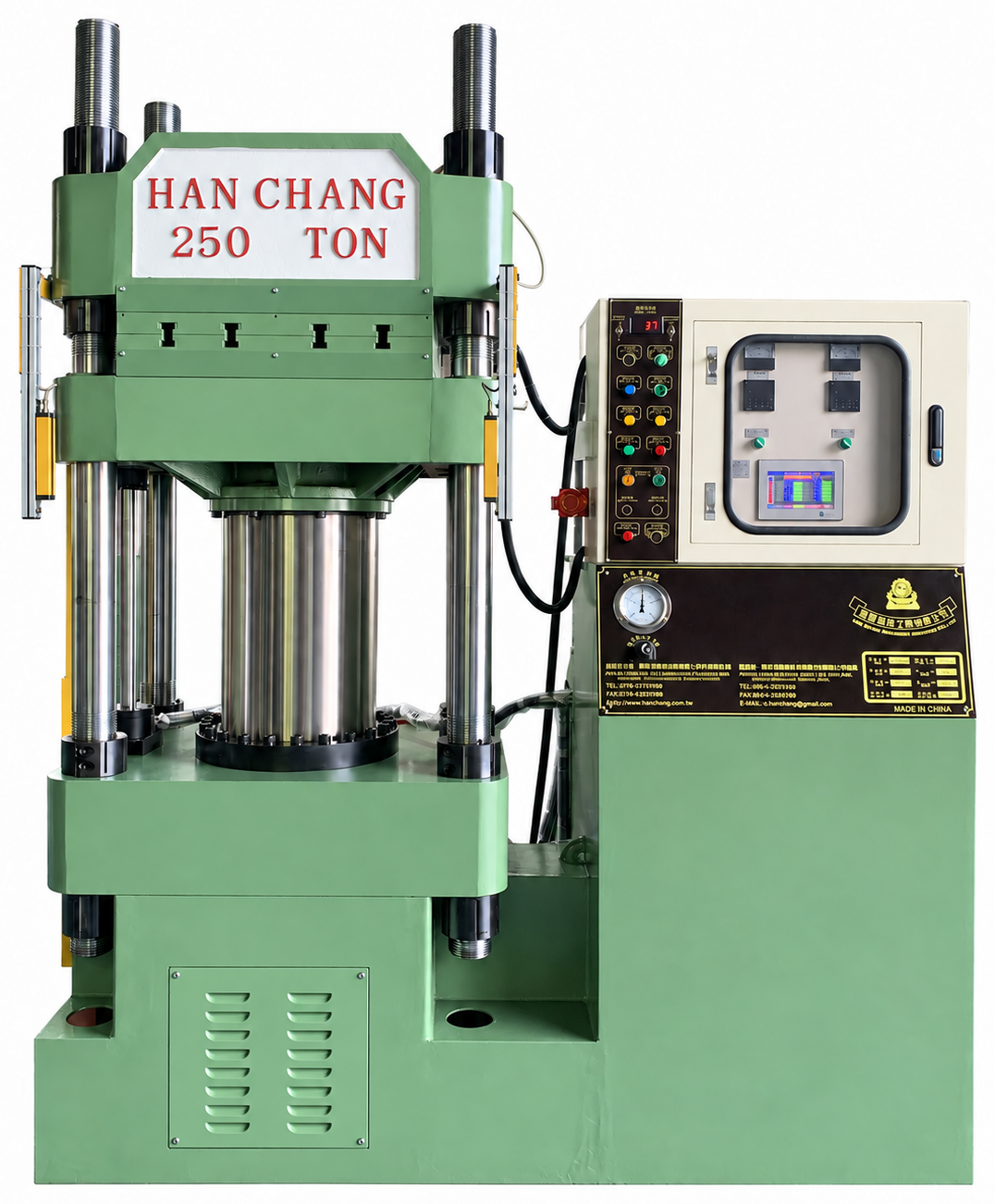
Machine advantages
Tune gas release to the compound and part
Adjust degassing count, duration and travel to release trapped air and reaction gases. These settings help address bubbles and surface defects alongside heating, holding and mold conditions.
Controlled approach and opening
Slow mold approach and opening help reduce impact on the tooling. Daylight and stroke can be selected around mold height, part removal and cleaning access.
One sequence for the key molding conditions
Coordinate heated platens, hydraulic holding and degassing within the press cycle, giving operators a practical basis for refining part shape, thickness and release.
Keep the settings established during trials
Save parameters used for a product, mold and compound. Repeat orders and shift changes can start from an existing setup instead of rebuilding the process settings each time.
For a factory built around single-color crockery orders, the single-color press puts investment into the working space and process settings the job actually needs. The listed 37–800 Ton range offers different platen sizes, daylight and strokes, while adjustable degassing and stored parameters support trials, mold changes and repeat production. Choose the press around your tableware and tooling, with room for practical cleaning and part handling.
How melamine tableware is made on the single-color press
The lower hydraulic cylinder presses upward while heated platens cure the melamine molding compound. Once each program starts, the press closes the mold, applies pressure, degasses, forms the part and opens. The process cards below explain plain and decorated tableware production.
Adjustable degassing count, time and travel let the venting sequence follow the compound, charge weight, wall thickness and cavity layout. Heating and pressure holding work together with these settings; stored parameters give repeat orders and shift changes an established starting point.
Without decals: molding → glazing
- Load the heated mold
The operator manually places molding compound into the already-heated mold.
- Start plain molding
The press closes, applies pressure, degasses, forms the body and opens.
- Add glazing powder
The operator adds glazing powder and starts the separate glazing-pressure program.
- Open and remove
After glazing is complete, the mold opens for manual product removal.
With decals: molding → decal → glazing
- Load and mold the body
Load compound into the heated mold and run plain molding until the mold opens.
- Place the decal
The operator adheres the paper to the formed piece and starts the separate decal program.
- Open again and add glaze
After the decal program finishes and the mold opens, add glazing powder and start glazing.
- Complete and remove
The glazing-pressure program finishes, then the mold opens for manual removal.
Glazing powder completes the melamine tableware surface. Decals add the artwork specified for the order, using the separate decoration stage shown above.
Melamine plates, bowls, cups and serving-tray production
Everyday crockery for restaurant and household orders
Use the single-color melamine press to manufacture dinner plates, rice bowls, soup bowls and small dishes for restaurant, catering and household tableware ranges. Adjustable heating, holding and degassing help match the molding conditions to each tool and part shape. Stored settings give repeat crockery orders an established setup, supporting consistent quality and efficient handovers between shifts.
Serving trays and cups for coordinated tableware ranges
Serving trays and cups that release through a conventional vertical-opening mold extend the range beyond bowls and plates. Different platen sizes, daylight and strokes accommodate the working-space needs of wider tray tools and taller cup tools. Produce each item with its corresponding mold and use decal designs to create a coordinated dinnerware range. Choose the dedicated cup molding machine for shapes requiring side-parting tooling.
One body color, with or without printed decoration
As a melamine crockery making machine, the single-color press serves factories producing plates, bowls, cups and trays with a single molded body color. Multicolor decal artwork does not require a two-color or three-color press: the single-color press forms the body, applies the separate decal program when needed and completes glazing. Food-contact compounds and finished tableware must meet the destination market’s requirements.
The single-color hot compression press series also covers phenolic/Bakelite and urea-formaldehyde molding compounds, glass-fiber-reinforced thermoset compounds, rubber and silicone. These applications need material-specific molds, heating and molding conditions; they do not automatically use the melamine decal and glazing workflow.
Choose the opening and color process
The single-color press is the direct choice for single-color products that release through a conventional upper/lower mold opening. Cup or deep-product tooling that needs side parting is better matched to the cup molding machine; sequential two-color or three-color molding calls for the two-color press or the three-color press. For heavier charges or thicker parts, high-frequency preheating can be planned with the press cycle and material transfer as a separate upstream step.
37–800 ton single-color press specifications
The single-color press range lists pressing forces from 37 to 800 Ton. Projected area, cavity count and the compound’s required molding pressure inform force selection; mold footprint, height, weight and removal method define the platen, daylight and stroke. This combination determines whether a press fits the tooling and the operator’s workflow.
Platen options at the same pressing force accommodate different mold layouts. Compare each model’s platen dimensions, daylight and stroke in the specification tables below.
Compare output per shift and the full purchasing scope
Melamine moulding machine prices depend on force, platen size, opening, stroke, heating and equipment options. For single-color production, start with existing-mold reuse, then add the preheating and finishing equipment required for your orders. This makes the scope of a stand-alone press or production-line quotation easy to compare.
The tables list each force rating’s platen sizes, cylinder, stroke, daylight, motor, heater capacity and overall dimensions. Where a rating lists multiple platen sizes and weights, use the complete set of figures corresponding to the selected configuration.
Model HCB-37
| Clamping force (Ton) | 37 |
|---|---|
| Plate size (m/m) | 330×340 |
| Cylinder diameter (m/m) | 150 |
| Stroke (m/m) | 370 |
| Daylight (m/m) | 450 |
| Pump pressure (kg/cm2) | 210 |
| Motor (HP) | 3 |
| Heater capacity (Kw) | 4.8 |
| Oil reservoir capacity (gallon) | 56 |
| Machine size LxWxH (m/m) | 1384x 900x 1690 |
| Net weight approx (kg) | 1100 |
Model HCB-50
| Clamping force (Ton) | 50 |
|---|---|
| Plate size (m/m) | 380×380 |
| Cylinder diameter (m/m) | 190 |
| Stroke (m/m) | 370 |
| Daylight (m/m) | 600 |
| Pump pressure (kg/cm2) | 210 |
| Motor (HP) | 3 |
| Heater capacity (Kw) | 5 |
| Oil reservoir capacity (gallon) | 56 |
| Machine size LxWxH (m/m) | 1555x 1050x 2060 |
| Net weight approx (kg) | 1400 |
Model HCB-80
| Clamping force (Ton) | 80 |
|---|---|
| Plate size (m/m) | 485×465 |
| Cylinder diameter (m/m) | 236 |
| Stroke (m/m) | 410 |
| Daylight (m/m) | 630 |
| Pump pressure (kg/cm2) | 210 |
| Motor (HP) | 3 |
| Heater capacity (Kw) | 7.6 |
| Oil reservoir capacity (gallon) | 70 |
| Machine size LxWxH (m/m) | 1720x1200x2115 |
| Net weight approx (kg) | 2750 |
Model HCB-100
| Clamping force (Ton) | 100 |
|---|---|
| Plate size (m/m) | 540×605 |
| Cylinder diameter (m/m) | 265 |
| Stroke (m/m) | 460 |
| Daylight (m/m) | 690 |
| Pump pressure (kg/cm2) | 210 |
| Motor (HP) | 5 |
| Heater capacity (Kw) | 10.6 |
| Oil reservoir capacity (gallon) | 100 |
| Machine size LxWxH (m/m) | 1940x1200x2370 |
| Net weight approx (kg) | 3700 |
Model HCB-150
| Clamping force (Ton) | 150 |
|---|---|
| Plate size (m/m) | 660×620 |
| Cylinder diameter (m/m) | 300/315 |
| Stroke (m/m) | 480 |
| Daylight (m/m) | 700 |
| Pump pressure (kg/cm2) | 210 |
| Motor (HP) | 7.5 |
| Heater capacity (Kw) | 10.6 |
| Oil reservoir capacity (gallon) | 100 |
| Machine size LxWxH (m/m) | 2030x1350x2370 |
| Net weight approx (kg) | 4000 |
Model HCB-200
| Clamping force (Ton) | 200 |
|---|---|
| Plate size (m/m) | 660×620
720×720 |
| Cylinder diameter (m/m) | 368 |
| Stroke (m/m) | 500 |
| Daylight (m/m) | 820 |
| Pump pressure (kg/cm2) | 210 |
| Motor (HP) | 10 |
| Heater capacity (Kw) | 15.2 |
| Oil reservoir capacity (gallon) | 120 |
| Machine size LxWxH (m/m) | 2300x1350x2670 |
| Net weight approx (kg) | 4500
5700 |
Model HCB-250
| Clamping force (Ton) | 250 |
|---|---|
| Plate size (m/m) | 720×720 |
| Cylinder diameter (m/m) | 400 |
| Stroke (m/m) | 520 |
| Daylight (m/m) | 810 |
| Pump pressure (kg/cm2) | 210 |
| Motor (HP) | 10 |
| Heater capacity (Kw) | 18.8 |
| Oil reservoir capacity (gallon) | 150 |
| Machine size LxWxH (m/m) | 2410x1350x2780 |
| Net weight approx (kg) | 5800
6200 |
Model HCB-300
| Clamping force (Ton) | 300 |
|---|---|
| Plate size (m/m) | 720×720
900×860 |
| Cylinder diameter (m/m) | 450 |
| Stroke (m/m) | 560 |
| Daylight (m/m) | 810 |
| Pump pressure (kg/cm2) | 210 |
| Motor (HP) | 15 |
| Heater capacity (Kw) | 20 |
| Oil reservoir capacity (gallon) | 200 |
| Machine size LxWxH (m/m) | 2480x1490x2945 |
| Net weight approx (kg) | 6500
8200 |
Model HCB-400
| Clamping force (Ton) | 400 |
|---|---|
| Plate size (m/m) | 660×620 720×720 980×860 |
| Cylinder diameter (m/m) | 500 |
| Stroke (m/m) | 560 |
| Daylight (m/m) | 950 |
| Pump pressure (kg/cm2) | 210 |
| Motor (HP) | 15 |
| Heater capacity (Kw) | 27 |
| Oil reservoir capacity (gallon) | 250 |
| Machine size LxWxH (m/m) | 2580x1500x3800 |
| Net weight approx (kg) | 6500
7200 8200 |
Model HCB-500
| Clamping force (Ton) | 500 |
|---|---|
| Plate size (m/m) | 800×800
900×900 1140×1100 |
| Cylinder diameter (m/m) | 560 |
| Stroke (m/m) | 580 |
| Daylight (m/m) | 1000 |
| Pump pressure (kg/cm2) | 210 |
| Motor (HP) | 15 |
| Heater capacity (Kw) | 30 |
| Oil reservoir capacity (gallon) | 250 |
| Machine size LxWxH (m/m) | 2810x1705x3135 |
| Net weight approx (kg) | 12000
13500 15800 |
Model HCB-600
| Clamping force (Ton) | 600 |
|---|---|
| Plate size (m/m) | 900×900
1200×1140 |
| Cylinder diameter (m/m) | 620 |
| Stroke (m/m) | 610 |
| Daylight (m/m) | 1020 |
| Pump pressure (kg/cm2) | 210 |
| Motor (HP) | 20 |
| Heater capacity (Kw) | 30 |
| Oil reservoir capacity (gallon) | 300 |
| Machine size LxWxH (m/m) | 3000x1750x4100 |
| Net weight approx (kg) | 14200
16000 |
Model HCB-800
| Clamping force (Ton) | 800 |
|---|---|
| Plate size (m/m) | 1800×1400 |
| Cylinder diameter (m/m) | 700 |
| Stroke (m/m) | 700 |
| Daylight (m/m) | 1060 |
| Pump pressure (kg/cm2) | 210 |
| Motor (HP) | 30 |
| Heater capacity (Kw) | 40 |
| Oil reservoir capacity (gallon) | 355 |
| Machine size LxWxH (m/m) | 3220x1850x4350 |
| Net weight approx (kg) | 26000 |
Melamine tableware production-line equipment and after-sales support
Han Chang supplies equipment for a complete melamine tableware production line: single-color hot compression presses, high-frequency preheaters, edge-grinding machines, polishing machines and decal-paper drying machines. A new factory can plan the linked stages with one equipment supplier; an established factory can add the preparation, molding or finishing equipment it needs.
Han Chang has factories in Taiwan and Mainland China, with customer-service and professional repair departments at the Mainland China factory. Discuss the installation location, operating requirements and service arrangements as part of the equipment purchase, with an identified contact for subsequent machine support.
Settings used for a product, mold and compound can be saved. For repeat production, shift changes or mold changes, operators can recall an existing set as the starting point for adjustment.
Customers can use the website’s existing messaging channels to send a fault video, control display, alarm message and machine sequence. Han Chang can review the information online and help resolve issues that can be handled remotely.
Applicable models may use Mitsubishi PLCs, Fuji Electric touchscreens and Japanese-brand oil seals. Actual makes depend on the machine specification and support future parts lookup and maintenance.
CE documentation can be provided when required for the selected specification. Safety circuits, guarding and electrical documents match the actual machine.
Single-Color Melamine Molding Machine — Buyer questions
What can the single-color press make, and is it limited to melamine?
The Han Chang single-color press is a hydraulic compression molding machine for single-color melamine bowls, plates, cups, trays and other tableware. Its material capability extends beyond melamine molding compound to phenolic/Bakelite and urea-formaldehyde molding compounds, glass-fiber-reinforced thermoset compounds, rubber and silicone. The single-color press range therefore supports several material applications rather than melamine alone.
Each material needs suitable tooling, heating and molding conditions. The decal and glazing sequence used for melamine crockery does not apply automatically to these other materials. Tableware compounds and finished products must also meet the food-contact requirements of their intended market.
Can a single-color melamine machine make tableware with multicolor designs?
Yes. Single-color describes the molded body of the tableware, not the number of colors printed on its decal paper. The single-color press can mold a single-color body, run a separate decal stage for the required decoration, and then complete the glazing stage. Glazing powder is required for melamine tableware whether or not decals are used.
Choose the two-color press when the body itself needs two colors, such as a red-and-black upper/lower combination. Choose the three-color press for a three-color appearance across the top, bottom and rim. Separating body colors from printed decoration avoids specifying a multicolor press merely because a decal contains several colors.
How does the single-color press produce melamine tableware without decals?
The operator manually loads compound into the already-heated mold and starts the plain molding stage. The press automatically closes, applies pressure, degasses, forms the part and opens. The operator then adds glazing powder.
The operator starts a separate glazing program, which applies pressure to complete that stage. The mold then opens for manual product removal. Undecorated tableware still has two separately started stages, with manual glazing-powder addition between them.
When are decal paper and glazing powder added to melamine tableware?
After compound is loaded into the heated mold, the plain molding stage presses, degasses and forms the body. Once the mold opens, the operator adheres the decal paper to the formed piece and starts the separate decal program.
Only after the decal program finishes and the mold opens again does the operator add glazing powder and start the glazing program. The press then completes that stage, opens and allows manual product removal. The sequence is plain molding → decal → glazing, with paper and powder added separately. Decals depend on the decoration required; glazing powder is a necessary part of this melamine tableware process.
What does the single-color press automatic cycle do, and where is an operator needed?
The single-color press groups mold closing, pressing, degassing, forming and opening into the relevant molding program. Once a stage is started, the press carries out its programmed actions rather than requiring the operator to control every hydraulic movement separately. Automatic molding cycles are a shared advantage of Han Chang’s melamine press range.
The operator loads compound into the heated mold, places decal paper when required, adds glazing powder at the appropriate open-mold stage and removes the finished piece. Plain molding, the optional decal program and glazing are started separately; the press performs the hydraulic actions within each stage. Plan shift output from pieces per mold, the required program times and manual handling, then coordinate preheating and finishing around that workflow.
How do multi-stage degassing and the 99-count setting help melamine molding?
The single-color press offers multi-stage degassing with a selectable count up to 99 and adjustable time and travel. These settings help factories match gas release to the molding compound, wall thickness and tool.
Set the degassing count to suit the material and mold, then coordinate mold temperature, pressure holding and charge weight to control surface finish and curing.
How should I choose single-color press tonnage and platen size for a plate or multi-cavity mold?
Start with the total projected area of all cavities and the compound’s molding-pressure requirement, then match the mold dimensions, weight, mounting and removal space. Single-color press specifications offer press forces from 37 to 800 Ton. Force rating and platen size answer different questions: one supplies molding force, while the other helps accommodate and support the tooling.
Han Chang can help select force, platen dimensions, daylight, stroke and heating from your product drawing or existing-tool information. Multi-cavity work also calls for sufficient total pressing force and a production plan covering the complete cycle.
Can I keep my existing melamine mold when buying a new single-color compression press?
Existing tooling is a useful starting point. Share mold photos and dimensions so Han Chang can match the mold height, weight, mounting, heating and part-removal clearance to a suitable press.
Reusing a mold is worth discussing before replacing tooling, with any mounting adapter or mold changes determined by the actual fit. A mold photograph, outside dimensions or the specifications of the existing press can start the discussion; a complete drawing package is not necessary for the first inquiry.
Which melamine molding machine should I choose?
Choose the single-color press for a single-color molded body, with decals used where printed decoration is required. The two-color press makes upper/lower two-color bodies, such as red-and-black crockery. The three-color press presses the first, middle and outer color layers in sequence to create tableware with different colors on the top, bottom and rim; it is intended for three-color body designs.
Choose a cup molding machine when the product’s outer shape needs side-parting tooling and locking. Conventional vertical-opening products can suit a single-color press. Match body-color design and mold opening to the products you intend to make.
Can Han Chang supply a complete melamine tableware production line?
Yes. Han Chang can supply the equipment required for a complete melamine tableware line, including hot compression molding presses, high-frequency preheaters, edge-grinding machines, polishing machines and decal-paper drying machines. The offer extends beyond a stand-alone single-color press to one-stop equipment supply for the surrounding processes.
A new factory can discuss the line around its tableware range, body colors and planned output. An existing factory can add equipment for material preparation, molding or finishing. Discussing the linked stages through one equipment supplier helps keep the purchasing scope aligned with the production workflow.
What customer-service and repair support is available for single-color press buyers?
Han Chang has factories in Taiwan and Mainland China. The Mainland China factory has customer-service and professional repair departments to support customers with equipment service and repair needs. Buyers can discuss service arrangements alongside the installation location and intended use of the press.
For assistance during operation, contact Han Chang through the official channels on this website with the machine model, equipment identification, a description of the problem and relevant photographs or video. These details help the service and repair teams understand the equipment and the reported issue.
What determines the price of a single-color melamine molding machine, and how can I request a quote?
Single-color press pricing depends on pressing force, platen size, tooling space, stroke, heating and the equipment configuration required. Presses with the same force rating can have different working space and equipment content. A stand-alone press quotation also differs from a package including preheating, edge grinding, polishing and decal-paper drying equipment.
Start with a product photograph, compound name, mold dimensions or details of your existing press. Body-color requirements, cavity count and planned output can then help define the configuration and supply scope. You do not need to know the correct tonnage before contacting Han Chang about a melamine crockery production project.
Request a single-color press or melamine production-line quotation
Send a product photo, tableware dimensions, compound name or existing mold details—whichever you have. Tell Han Chang whether you need a stand-alone press or line equipment, the body colors and planned output. We can match press force, platen space, opening and heating, then discuss cavity count, factory power and operator workflow.
Related Reading: Melamine Molding and Line Planning
These guides connect common melamine molding problems with practical production-line choices: bubbles, flash, uneven thickness, tooling, compound preparation, degassing and pressure holding. Use them to plan the equipment and linked processes for your tableware orders.
- Melamine molding problems: burrs, bubbles, uneven thickness and demolding stability
- Melamine molding production line planning: press, preheater, mold and operator workflow planning
- Commercial melamine tableware molding equipment: equipment planning by tableware size, cavity count and output target