
Timed Heating and Automatic Lid for Melamine Preheating: A Clear Handoff
Han Chang’s High-Frequency Melamine Powder Preheater prepares a weighed melamine molding compound charge before it enters the compression mold. It suits melamine tableware plants that use manual mold loading and want each preheating batch to end at a clear, actionable point: when the set time is complete, heating stops and the lid opens automatically. The operator can then unload the softened charge and transfer it to the press. For buyers, the value is practical—clearer coordination between two separate process stages, no repeated manual lifting or lowering of the lid, and a better basis for scheduling the preheated charge close to the press’s next loading point.
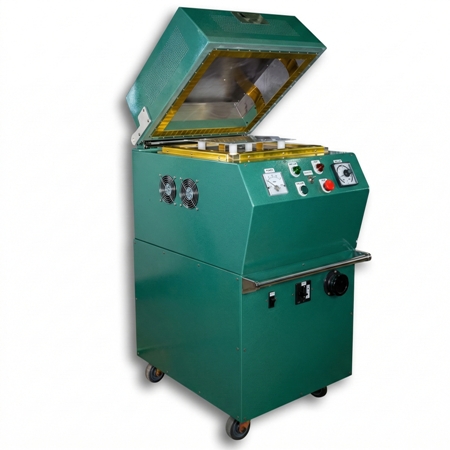
One charge: from molding powder to the compression mold
What the Machine Prepares—and Who Should Consider It
The machine takes melamine compound from powder in a suitable preheating container to a soft preheated cake or lumps. This is an intermediate charge prepared for manual transfer, not a finished molded product. The downstream press still completes compression molding and curing.
This high-frequency melamine powder preheater is a strong fit for manufacturers that:
- produce melamine tableware such as bowls, plates, cups or trays;
- load molding charges into the press manually;
- want a defined end point for each preheating batch;
- prefer automatic lid movement while retaining operator control of material handling;
- need to coordinate preheating with an existing or planned press-loading schedule; or
- want to add upstream compound preparation to a suitable existing molding press.
For a factory comparing a melamine powder high frequency preheater with other preparation equipment, the purchasing question should not begin with RF theory. It should begin with the charge: what material must be prepared, how much is loaded for each mold cycle, where the container will sit, and when the press will be ready for the next manual loading action.
Timed Heating Creates an Explicit End to Every Batch
The main operating advantage in this application is the combination of timed heating and automatic lid for melamine preheating. The operator sets the heating time for the working condition and starts the batch. At timer completion, the machine stops heating and opens the lid. That sequence makes the end of the preheating batch explicit instead of leaving the handoff dependent on repeated lid handling.
The function is time-based. It must not be described as a temperature-triggered stop. Han Chang does not claim that this machine ends heating when a target material temperature is detected. The timer provides a defined completion point; the applicable heating time still has to be matched to the compound and loading condition.
That distinction matters to production planners. The machine does not decide when the downstream mold is available, but it gives the team a clear preheating endpoint around which work can be arranged. When the press schedule is understood, the preheating batch can be started so the softened charge is ready close to the press’s next loading point. This is a scheduling benefit, not a claim of automatic line synchronization.
Automatic Lid Movement Reduces Repetitive Manual Handling
The lid opens and closes automatically. Operators therefore do not need to lift and lower it manually for every batch. This removes a repeated handling action while keeping the division of work easy to understand.
The actual batch handoff is:
- Weigh: The operator weighs the required melamine compound charge.
- Load: The operator loads the compound into a suitable preheating container.
- Place: The operator places the container in the RF preheater.
- Heat: The machine runs for the set time; its lid movement is automatic.
- Complete: When the timer finishes, heating stops and the lid opens automatically.
- Unload and transfer: The operator removes the container and transfers the soft cake or lumps into the compression mold.
- Mold and cure: The downstream press completes compression molding and curing.
Automatic lid opening and closing must not be confused with automatic feeding. The melamine preheating machine does not automatically weigh the powder, fill the container, place it in the heating area, remove the preheated charge or feed that charge into the press. Operators remain responsible for weighing, loading, placing, unloading and transferring the material.
Why the Batch Handoff Is Worth Buying
Many equipment descriptions stop at “preheating before molding.” The more useful purchasing benefit here is what happens at the boundary between preheating and pressing.
First, the end of each batch is unmistakable: the set time finishes, heating stops and the lid opens. Second, automatic opening and closing removes repeated manual lid lifting and lowering. Third, the production team can plan the batch around the next mold-loading opportunity rather than treating preheating as an isolated activity.
Together, these functions support a clear operating rhythm:
- the preheater prepares the charge;
- timer completion defines the handoff point;
- the operator unloads and transfers the softened material; and
- the press performs the compression molding and curing stage.
This makes the machine particularly relevant where operators already manage manual mold loading and need a focused addition upstream. A Han Chang thermoset powder preheater can be discussed for suitable molding compounds, but the confirmed post-preheating form described here—soft cake or lumps—specifically applies to melamine compound. It should not be generalized to every thermoset formulation without checking the actual material.
The equipment can also be considered for a suitable existing press. Adding preheating does not require buyers to describe the machine as a stand-alone production line, and it does not turn separate machines into an automatically fed line. Its value is more precise: it prepares the charge and creates a clear manual transfer point before the press. For the next level of process control, see our separate guide to recording transfer time between melamine preheating and mold loading; this article stays focused on the machine-defined handoff point.
Select the Power Option Around the Real Batch and Press Schedule
Han Chang offers 3, 5, 7, 10 and 25 kW models as discrete power options. They are not a continuously adjustable 3–25 kW range, and the power designation alone should not be converted into a promised batch capacity, production rate or hourly electricity consumption.
Selection should be based on the actual production conditions:
- molding compound and formulation;
- charge weight per batch;
- available container space and container dimensions;
- the downstream press-loading schedule; and
- the plant electrical supply.
These factors belong in one discussion because the preheater is being selected for a specific handoff. A larger nominal power option is not automatically the best choice if the charge, container and press rhythm point elsewhere. Likewise, press tonnage alone does not define the correct preheater.
For an RFQ, send Han Chang the compound name, charge weight, available container details, plant supply and the timing of manual press loading. If the project involves an existing machine, include the press model or photos and the intended operator route. Han Chang can then discuss the suitable discrete power option and how to position the preheater around the real batch sequence.
Request a Preheater Recommendation for Your Loading Sequence
If your plant needs timed heating, an automatically opening and closing lid, and a clear manual handoff into a melamine compression press, contact Han Chang for an RFQ for the High-Frequency Melamine Powder Preheater. Share your compound, batch weight, container space, plant supply and press-loading schedule to receive a configuration discussion based on the job—not on a generic RF preheating assumption.