
Rubber Injection Molding Machine for Seals and Gaskets
Han Chang manufactures vertical rubber injection molding machines for making O-rings, oil seals and gaskets from NBR, EPDM, FKM and other rubber compounds. A screw preplasticizes manually supplied rubber strip; an overhead hydraulic plunger injects it into the closed mold. The rubber cures before the mold opens for manual part removal.
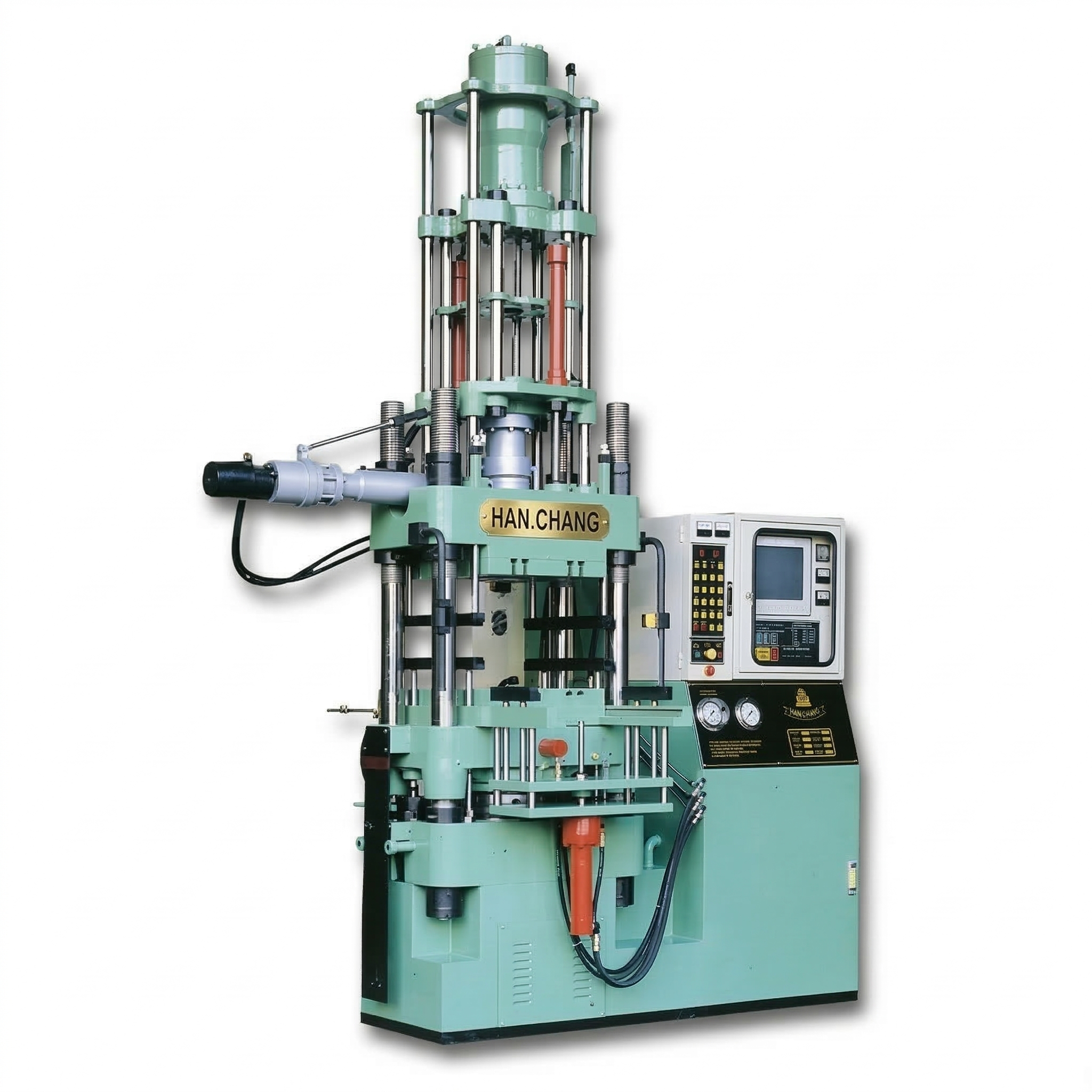
Machine advantages
Three pressure stages and four flow stages are available for both injection and the overall hydraulic cycle, alongside mold-opening/closing venting. This gives the production team practical ways to adjust filling and machine movements. Compare the available models by shot volume, clamping force and mold space to select equipment for your tooling and production requirements.
Prepare the strip, then fill the closed mold
Screw feeding and preplasticizing prepare the rubber before the overhead hydraulic plunger delivers it into the closed mold. The injection unit supplies compound to the cavities for products such as O-rings and gaskets, keeping material preparation and injection filling as distinct machine functions.
Adjust more than a single pressure setting
Both injection and the hydraulic cycle have three pressure stages and four flow stages. Operators can adjust conditions to suit compound flow and tooling needs rather than use one pressure and flow setting throughout each action. The staged controls provide practical adjustment points during mold trials.
Venting through mold opening and closing
The press includes mold-opening/closing venting to help release gas from the mold. Used alongside the mold’s vent paths and suitable compound curing conditions, it provides a way to address trapped gas as part of the molding process.
Choose capacity around the complete mold
The model range offers different shot volumes, clamping forces, platen sizes and opening strokes. Match the rubber needed for the complete shot with mold mounting and part-removal space, rather than choosing a machine from part size or tonnage alone.
Rubber injection and curing process
Feed strip and preplasticize
The operator supplies rubber strip. The screw conveys and preplasticizes the compound in preparation for injection.
Inject into the closed mold
With the mold closed, the overhead hydraulic plunger injects the prepared compound into the mold cavities.
Cure the rubber in the mold
The rubber is heated and vulcanized in the mold to form the part. Curing conditions depend on the compound and product requirements.
Open and remove the parts
After curing, the mold opens. The operator removes the molded rubber parts for inspection and subsequent production operations.
Materials and rubber part applications
The Han Chang rubber injection molding machine produces O-rings, oil seals, molded gaskets, dust boots and vibration-damping parts for equipment sealing, moving-part protection and cushioning. Screw preplasticizing, plunger injection into a closed mold and in-mold vulcanization turn rubber compound into components with distinct shapes and functions.
O-rings and oil seals: sealing joints and rotating shafts
O-rings compress within grooves to close gaps between mating components and limit liquid or gas leakage. Oil seals work around rotating shafts to retain lubricant and help keep external dirt out. These products serve distinct sealing duties at component joints and shaft interfaces.
Plunger injection sends preplasticized compound through runners into the cavities, supporting repeat production with a suitably designed multi-cavity mold. Staged pressure and flow settings provide filling adjustments for the compound, runner layout and cavity arrangement.
Molded gaskets: sealing housings, covers and pipe joints
Rubber gaskets compress between mating surfaces to fill gaps and help prevent leakage at equipment housings, covers and pipe joints. Unlike simple gaskets cut from sheet, molded designs can incorporate raised edges, grooves and changes in thickness to suit three-dimensional sealing profiles.
Injection molding combines cavity filling with in-mold vulcanization to form raised edges, grooves and varying section thicknesses. For gasket manufacturers, these three-dimensional profiles are a practical reason to invest in molding equipment rather than rely solely on sheet-cutting equipment.
Dust boots and vibration-damping parts: protection and cushioning
Dust boots flex with moving joints or extending mechanisms while helping keep dirt away from protected components. Rubber vibration-damping parts serve a different purpose: at equipment supports or contact points, their elastic deformation cushions impacts and reduces vibration transmission.
Flexible boot profiles and damping parts present different section thicknesses and compound-flow requirements. The machine provides adjustable injection conditions for each job, with mold-opening/closing venting to help release gas from the mold.
Specifications and machine selection
Start your model comparison with maximum shot volume, clamping force, platen dimensions and opening stroke. The detailed specifications also cover the screw, drive, heating and machine dimensions. Model numbers identify the equipment; they are not clamping tonnages. Shot capacity in C.C. is a volume, not a weight in grams.
Spec/Type HCR-500
| Clamping force (Ton) | 150 |
|---|---|
| Plate size (m/m) | 360×460 |
| Cylinder diameter (m/m) | 300/315 |
| Stroke (m/m) | 410 |
| Motor (HP) | 10 |
| Heater power (Kw) | 7.7 |
| Maximum shot volume (C.C) | 500/1000 |
| Screw (m/m) | 45 |
| Screw speed (RPM) | 0-120 |
| Material size(Txw) (m/m) | 10×46 |
| Kerosene pump (HP) | 1/2 |
| Oil reservoir capacity (gallon) | 100 |
| Machine size LXWXH (m/m) | 2430x1990x3330 |
| Net weight approx (kg) | 5500 |
Spec/Type HCR-1000
| Clamping force (Ton) | 200 |
|---|---|
| Plate size (m/m) | 520×520 |
| Cylinder diameter (m/m) | 368 |
| Stroke (m/m) | 500 |
| Motor (HP) | 15 |
| Heater power (Kw) | 13 |
| Maximum shot volume (C.C) | 1000/1500 |
| Screw (m/m) | 45 |
| Screw speed (RPM) | 0-120 |
| Material size(Txw) (m/m) | 10×46 |
| Kerosene pump (HP) | 1/2 |
| Oil reservoir capacity (gallon) | 150 |
| Machine size LXWXH (m/m) | 2790x2080x3700 |
| Net weight approx (kg) | 6800 |
Spec/Type HCR-1500
| Clamping force (Ton) | 200 |
|---|---|
| Plate size (m/m) | 520×520
520×580 |
| Cylinder diameter (m/m) | 368 |
| Stroke (m/m) | 500 |
| Motor (HP) | 15 |
| Heater power (Kw) | 13 |
| Maximum shot volume (C.C) | 1500/2000 |
| Screw (m/m) | 45 |
| Screw speed (RPM) | 0-120 |
| Material size(Txw) (m/m) | 10×46 |
| Kerosene pump (HP) | 1/2 |
| Oil reservoir capacity (gallon) | 150 |
| Machine size LXWXH (m/m) | 2790x2080x3700 |
| Net weight approx (kg) | 7000 |
Spec/Type HCR-2000
| Clamping force (Ton) | 300 |
|---|---|
| Plate size (m/m) | 570×585
620×650 |
| Cylinder diameter (m/m) | 450 |
| Stroke (m/m) | 600 |
| Motor (HP) | 20 |
| Heater power (Kw) | 16.5 |
| Maximum shot volume (C.C) | 2000/2500 |
| Screw (m/m) | 45 |
| Screw speed (RPM) | 0-120 |
| Material size(Txw) (m/m) | 10×46 |
| Kerosene pump (HP) | 1/2 |
| Oil reservoir capacity (gallon) | 165 |
| Machine size LXWXH (m/m) | 2860x2280x4050 |
| Net weight approx (kg) | 9000 |
Spec/Type HCR-4000
| Clamping force (Ton) | 500 |
|---|---|
| Plate size (m/m) | 700×720 |
| Cylinder diameter (m/m) | 560 |
| Stroke (m/m) | 700 |
| Motor (HP) | 25 |
| Heater power (Kw) | 18.5 |
| Maximum shot volume (C.C) | 3000/4000 |
| Screw (m/m) | 50 |
| Screw speed (RPM) | 0-120 |
| Material size(Txw) (m/m) | 10×46 |
| Kerosene pump (HP) | 1/2 |
| Oil reservoir capacity (gallon) | 200 |
| Machine size LXWXH (m/m) | 2900x2350x4000 |
| Net weight approx (kg) | 13000 |
You do not need to choose a model before contacting Han Chang. A part photo or drawing is a useful starting point. If tooling is already available, its overall dimensions and cavity count make the machine discussion more specific.
Tooling and equipment quotations
An existing mold drawing and the current press specifications help define how a new machine will fit the job. Compare platen space, mounting arrangements, opening stroke and the injection interface to identify tooling adaptation needs before choosing equipment by tonnage alone.
Use the same product and tooling requirements when comparing suppliers. Identify the model, injection unit, electrical requirements and scope of supply, with tooling and ancillary needs listed separately. A clearly defined equipment package makes the price comparison useful for purchasing and production planning.
Buyer questions
Which rubber products and compounds is this machine used for?
The Han Chang rubber injection molding machine processes natural rubber and synthetic rubbers such as NBR, EPDM and FKM, matched to the formulation and vulcanization requirements. Applications include O-rings for sealing component joints, oil seals for retaining lubricant around rotating shafts, molded gaskets for housings and pipe joints, dust boots for protecting moving mechanisms, and vibration-damping parts for equipment supports and cushioning.
Does the screw inject the rubber, or does a plunger do the injection?
The screw conveys and preplasticizes the manually supplied rubber strip. An overhead hydraulic plunger then injects the compound into the already closed mold. The rubber cures in the mold, which opens for manual part removal. This differs from compression molding, where a charge is placed directly into an open mold cavity before closing and pressing.
What do the three pressure stages and four flow stages control?
Both the injection action and the overall hydraulic cycle have three pressure stages and four flow stages. Operators can adapt pressure and flow to compound behavior, part geometry and runner layout, giving filling conditions and machine movements settings suited to the production task. Working conditions are established through mold trials.
Does the vertical rubber injection press have a venting function?
Yes. The machine has mold-opening/closing venting to help gas escape from the mold. Its effectiveness also depends on the mold’s vent paths, the compound and the molding conditions. When investigating air marks or incomplete filling, consider these factors together instead of simply increasing injection pressure.
How should I compare shot capacity in C.C. with a specification in grams?
C.C. means cubic centimeters and describes volume. Grams describe mass, so conversion requires the density of the actual rubber compound. The required shot includes the material for every cavity and the runners. Maximum shot volume is therefore not the weight of a single part or a direct statement of finished-part weight per cycle.
How do I select the right model and clamping force?
Match the complete shot requirement, clamping force, platen dimensions, opening stroke and mold mounting conditions. Clamping demand depends on projected cavity area, cavity pressure and tooling design, not part dimensions alone. Check the specifications for the proposed configuration: a model number is an identifier, not a tonnage rating, and more tonnage alone does not establish a better fit.
How many rubber parts can the machine produce per shift?
Output depends on the working cavity count and the complete production cycle, including strip supply, injection, curing, mold opening, manual removal and shop-floor handling. Compound formulation and part thickness affect curing time. Use relevant cycle records or mold-trial data to discuss a production target; maximum shot capacity alone cannot establish parts per shift.
What information is needed for a rubber injection moulding machine quotation?
Start with a part photo or drawing, the rubber compound and your intended output. Add mold dimensions and cavity count if tooling already exists; you do not need a complete tooling file to begin the conversation. Price should correspond to the selected model, injection unit and agreed scope of supply, with electrical requirements, tooling and ancillary needs clearly identified so quotations address the same production task.
Find the right rubber injection press for your parts
Send Han Chang a product photo, drawing or existing machine requirement. Tell us what you plan to mold and your production target to start a practical equipment-selection and quotation discussion.